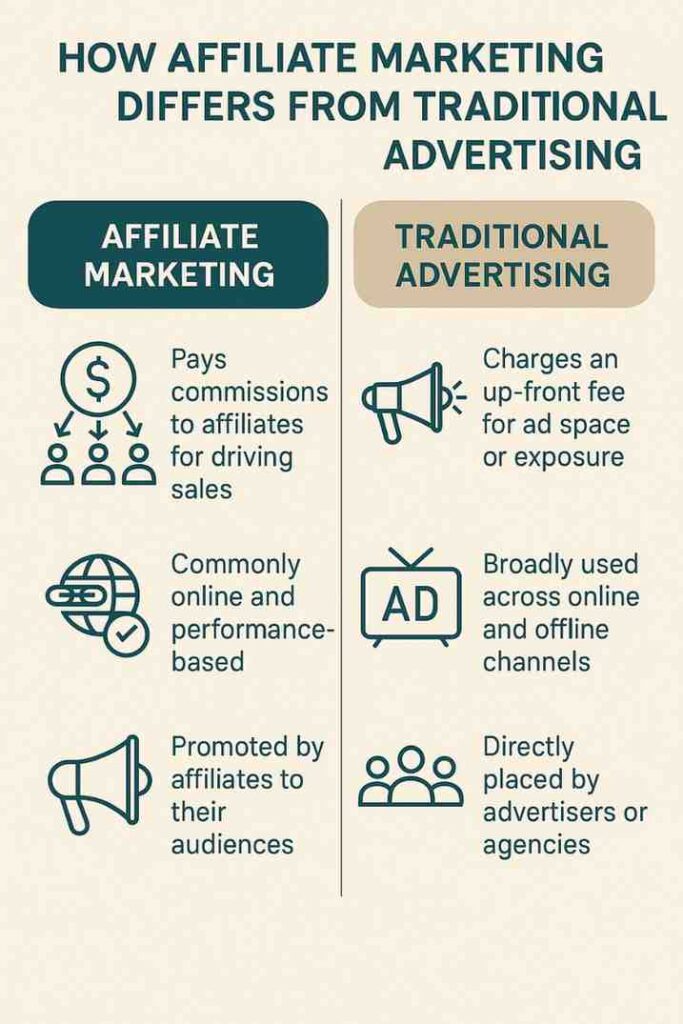
Affiliate marketing and traditional advertising are two common yet distinct methods businesses use to promote their products or services. While both aim to reach and influence consumers, they operate on fundamentally different models, strategies, and cost structures. The digital age has made affiliate marketing increasingly popular, but traditional advertising still remains significant across many industries.
In this comprehensive explanation, we’ll explore the key differences between affiliate marketing and traditional advertising by examining their definitions, structures, methodologies, tracking capabilities, cost models, audience targeting, and effectiveness. A practical example will be included to help illustrate these differences in action.
1. Definition and Core Concept
Affiliate Marketing
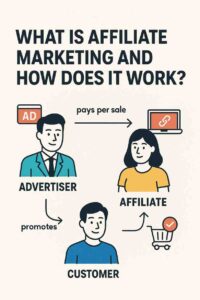
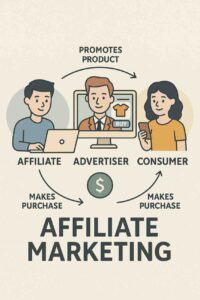
Affiliate marketing is a performance-based digital marketing strategy where a business rewards third-party publishers (affiliates) for driving traffic or sales to its website through the affiliate’s own marketing efforts. Affiliates only get paid when a specific action is completed — such as a sale, signup, or download.
In essence, it’s a pay-for-performance model. Businesses leverage the reach and influence of affiliates (bloggers, influencers, YouTubers, etc.) to promote their offerings.
Traditional Advertising
Traditional advertising refers to more conventional forms of marketing — such as TV commercials, radio spots, billboards, newspaper ads, magazine placements, and flyers. These ads are typically created and paid for upfront, regardless of how effective they are in driving results.
Traditional advertising is generally pay-for-exposure rather than performance. Companies invest in media space and time to raise awareness, not necessarily to guarantee conversions.
2. Cost Model
Affiliate Marketing:
-
Performance-Based: Advertisers pay affiliates only when a predetermined action occurs (e.g., a purchase, form submission).
-
Low Risk: There’s minimal financial risk because businesses don’t pay unless results are delivered.
-
Flexible Commission Structures: Advertisers can offer flat-rate payments, tiered commissions, or percentages of sales.
Traditional Advertising:
-
Upfront Payments: Advertisers must pay in advance to buy ad space or time, regardless of the campaign’s results.
-
High Cost: Especially for TV, radio, or print ads, the costs can be significantly higher due to production and distribution expenses.
-
No Guarantee of Return: Businesses might invest heavily without a clear return on investment (ROI).
3. Reach and Targeting
Affiliate Marketing:
-
Niche Targeting: Affiliates often have dedicated audiences in specific niches (e.g., fitness, tech, finance). This allows for targeted promotions that speak directly to consumer needs.
-
Trust Factor: Consumers tend to trust product recommendations from influencers or bloggers they follow regularly.
-
Data-Driven: Affiliates can use analytics tools to tailor promotions to user behavior, making the targeting highly specific and personal.
Traditional Advertising:
-
Broad Reach: Traditional advertising targets a general audience. For example, a TV commercial during prime time may reach millions, but many viewers may not be potential customers.
-
Less Personalization: Ads are standardized and not tailored to individual viewer preferences.
-
Mass Market Strategy: It works well for brand awareness campaigns but is less effective for direct-response goals.
4. Channel and Medium
Affiliate Marketing:
-
Digital Platforms: Operates entirely online — through websites, social media platforms, email marketing, podcasts, and YouTube.
-
Content-Centric: The focus is on content that educates, reviews, or entertains while subtly promoting the product.
-
SEO and Social Media Driven: Organic traffic and engagement are key drivers of success.
Traditional Advertising:
-
Offline Media: Uses physical or broadcast channels like television, radio, newspapers, and billboards.
-
Ad-Centric: Content is solely promotional and interruptive in nature (e.g., commercial breaks, print ad spreads).
-
Event-Based: Traditional ads are often tied to events, seasons, or specific time slots.
5. Measurement and Tracking
Affiliate Marketing:
-
Precise Tracking: Uses tracking links, cookies, and affiliate IDs to monitor user behavior from click to conversion.
-
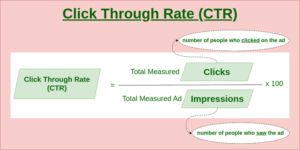
Real-Time Analytics: Affiliates and merchants can access dashboards showing performance metrics (click-through rate, conversion rate, etc.).
-
Attribution Clarity: Affiliates get credit for referrals, and merchants know exactly which affiliate drove which result.
Traditional Advertising:
-
Limited Tracking: It’s difficult to measure how many people took action because of a TV or billboard ad.
-
Estimates and Surveys: Businesses rely on third-party agencies for ratings, reach estimates, and consumer feedback.
-
Less Attribution: Hard to know which channel or campaign led to a purchase unless the customer self-reports.
6. Payment Structure
Affiliate Marketing:
-
Commission-Based: Payment is tied to measurable actions like purchases, signups, or app installs.
-
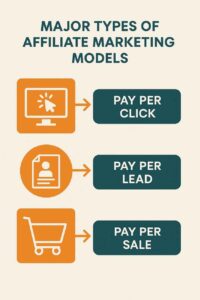
Flexible Payout Models: Options include pay-per-sale (PPS), pay-per-click (PPC), and pay-per-lead (PPL).
-
Scalable Costs: As sales increase, so does the cost — but so does revenue.
Traditional Advertising:
-
Flat-Rate Pricing: Pay a set amount for a defined duration, reach, or ad size, regardless of effectiveness.
-
No Direct Link to Sales: You pay for visibility, not outcomes.
-
One-Time Investment: No recurring cost tied to actual product sales or consumer actions.
7. Involvement of Third Parties
Affiliate Marketing:
-
Involves affiliates who act as independent marketers. They choose which products to promote and how to promote them.
-
May also involve affiliate networks (e.g., CJ Affiliate, ShareASale) that connect merchants with affiliates, manage tracking, and handle payments.
Traditional Advertising:
-
Involves advertising agencies, creative studios, media buyers, and sometimes celebrities or spokespeople.
-
Requires production teams for video shoots, graphic design, and editing.
8. Flexibility and Control
Affiliate Marketing:
-
High Flexibility: Both affiliates and merchants can start, stop, or modify campaigns quickly.
-
Low Barrier to Entry: Anyone with an online presence can become an affiliate.
-
Test-and-Optimize Approach: Campaigns can be optimized in real time for better performance.
Traditional Advertising:
-
Lower Flexibility: Once an ad is published or aired, changes are difficult or impossible.
-
High Barrier to Entry: Requires significant budget, planning, and coordination.
-
One-Shot Campaigns: Less opportunity to refine messaging post-launch.
9. Consumer Perception
Affiliate Marketing:
-
Feels more organic and personal — often part of helpful content like reviews or tutorials.
-
Consumers often don’t mind affiliate links if the content is valuable and trustworthy.
-
Less intrusive and more native to the platform (e.g., a YouTube video reviewing a product).
Traditional Advertising:
-
Seen as interruptive — breaks in shows, pop-up ads in magazines, or loud commercials.
-
May lead to ad fatigue — consumers skipping or ignoring the ad altogether.
-
Often more about branding than utility.
10. Example: Fitness Product Promotion
Let’s compare how a company might promote a new protein supplement using both affiliate marketing and traditional advertising.
Affiliate Marketing Scenario:
A fitness brand partners with a popular fitness YouTuber and offers them an affiliate link to the new supplement.
-
The YouTuber posts a video titled “Best Protein Supplements for Lean Muscle” and includes a link in the description.
-
Viewers trust the YouTuber’s expertise and click the link to make a purchase.
-
The affiliate earns a 15% commission on each sale.
-
The company only pays when a sale happens.
Traditional Advertising Scenario:
The same brand buys a 30-second ad slot on a sports TV channel.
-
The ad airs during a cricket match, watched by millions.
-
Many viewers see the ad, but the brand has no direct way to measure how many of them purchased the product.
-
The ad costs ₹10,00,000 for one slot, whether it results in sales or not.
-
There is no direct engagement or feedback from consumers.
Conclusion
Affiliate marketing and traditional advertising are both valuable in their own right, but they differ significantly in approach, strategy, and execution.
| Aspect | Affiliate Marketing | Traditional Advertising |
|---|---|---|
| Payment Model | Performance-based (e.g., per sale or lead) | Upfront payment for ad space or time |
| Risk Level | Low (pay only when results are delivered) | High (pay regardless of results) |
| Targeting | Highly targeted and niche | Broad and general |
| Tracking | Real-time, detailed tracking available | Limited tracking, estimates based on reach |
| Cost Efficiency | Cost-effective and scalable | Expensive with no guaranteed ROI |
| Consumer Perception | Organic and trustworthy | Often interruptive or ignored |
While traditional advertising is ideal for brand-building and reaching large audiences quickly, affiliate marketing excels in performance, accountability, and adaptability. In today’s data-driven and digital world, affiliate marketing provides businesses — especially small and medium enterprises — a practical and profitable path to grow sales with lower risk and better targeting.
Each model has its place in a comprehensive marketing strategy, but understanding the differences is essential for choosing the right approach for specific business goals.