Home Blog Page 57

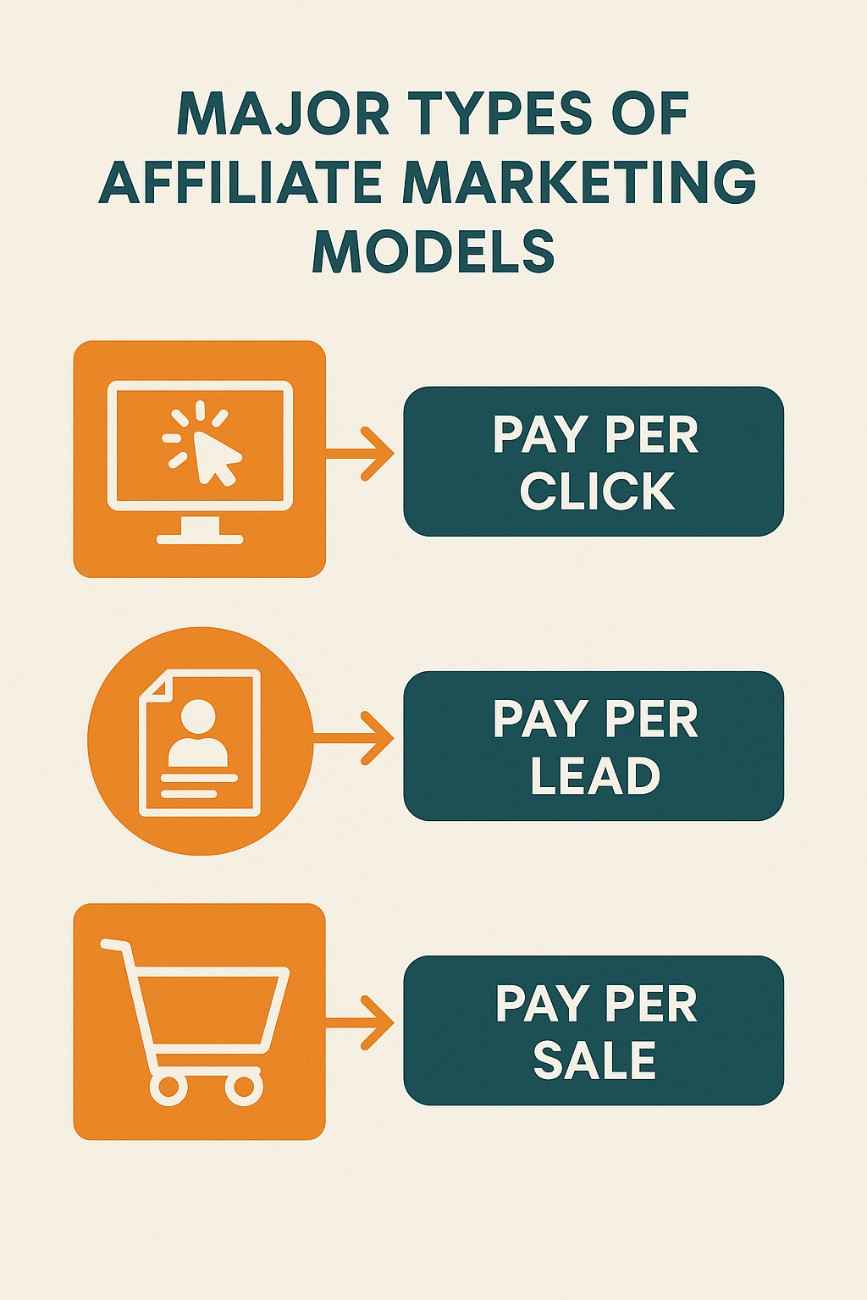
What are the major types of affiliate marketing models?

Affiliate marketing has grown into one of the most powerful and flexible ways to generate revenue online. Whether you’re a business looking to promote your products or an individual seeking passive income opportunities, affiliate marketing offers a performance-based solution where marketers (affiliates) earn a commission for referring traffic, leads, or sales to a merchant (advertiser).

But affiliate marketing is not a one-size-fits-all model. In fact, it has evolved into several types of models, each with its own structure, goals, and payment system. Understanding the major types of affiliate marketing models is crucial for both advertisers and affiliates in choosing the right strategy that aligns with their business objectives and marketing style.

In this essay, we will explore in detail the major types of affiliate marketing models, their structures, how they work, their benefits and limitations, and provide real-world examples to make each type more understandable.


1. Pay-Per-Sale (PPS)

Definition:

Pay-per-sale is the most common and straightforward affiliate marketing model. In this model, affiliates earn a commission when the customer they refer makes an actual purchase.

How It Works:

  • The affiliate promotes a product using a unique affiliate link.

  • A consumer clicks the link and buys the product.

  • The affiliate receives a percentage of the sale (commonly 5%–50%, depending on the product).

Advantages:

  • Low risk for advertisers: they only pay for successful sales.

  • High earning potential for affiliates, especially with high-ticket items.

Disadvantages:

  • No earnings unless a sale is made.

  • It may take time to convert visitors into buyers.

Example:

An affiliate writes a blog post reviewing various fitness trackers. They include affiliate links to Amazon. When a reader clicks the link and buys a Fitbit worth ₹10,000, the affiliate earns a 6% commission, i.e., ₹600.


2. Pay-Per-Click (PPC)

Definition:

In the pay-per-click model, affiliates earn money whenever a user clicks on the advertiser’s link, regardless of whether a purchase is made.

How It Works:

  • The affiliate embeds an ad or link in their content.

  • A visitor clicks the link and is taken to the advertiser’s website.

  • The affiliate gets paid per click (usually a few cents to a few rupees).

Advantages:

  • Low barrier to entry for affiliates; clicks are easier to get than sales.

  • Immediate earnings, even if users don’t buy anything.

Disadvantages:

  • High risk for advertisers: they pay even if the clicks don’t convert.

  • Affiliates may focus on quantity over quality, leading to low conversion rates.

Example:

A tech blogger places banner ads for a mobile phone brand. For each click from their blog to the advertiser’s website, they earn ₹2. If 1,000 people click the ad, they earn ₹2,000, even if no purchases are made.


3. Pay-Per-Lead (PPL)

Definition:

The pay-per-lead model rewards affiliates for directing visitors who perform a specific action, such as filling out a form, signing up for a newsletter, or registering for a free trial.

How It Works:

  • The affiliate shares a link to a landing page with a form or signup.

  • A visitor clicks the link and completes the desired action.

  • The affiliate gets paid a fixed amount per lead.

Advantages:

  • Easier than PPS as no purchase is needed.

  • Useful for services or products with a long sales cycle.

Disadvantages:

  • Leads may not convert into actual customers.

  • Can be subject to fraud (fake sign-ups or bots).

Example:

A finance blog refers users to a credit card comparison website. Every time a user signs up for a free credit score report, the affiliate earns ₹100. If 50 users sign up, they earn ₹5,000.


4. Two-Tier Affiliate Marketing

Definition:

Two-tier affiliate marketing allows affiliates to not only earn commissions for referring customers but also for referring new affiliates to the program.

How It Works:

  • An affiliate refers another affiliate to the merchant’s program.

  • When the second-tier affiliate makes a sale, the first affiliate earns a small percentage (often 5%–10%) in addition to their own commissions.

Advantages:

  • Encourages affiliates to grow a team or network.

  • Creates long-term income opportunities.

Disadvantages:

  • Requires a strong network-building ability.

  • Often lower commission on the second tier.

Example:

An affiliate marketer joins a software affiliate program and refers another marketer to join as well. The second affiliate sells ₹50,000 worth of software in a month. The referring affiliate earns 10%, i.e., ₹5,000 as a second-tier commission.


5. Cost Per Install (CPI)

Definition:

This model is common for mobile app and software promotions. Affiliates get paid every time someone installs an app through their referral link.

How It Works:

  • The affiliate promotes a mobile app or desktop software.

  • A user installs the app via the affiliate’s link.

  • The affiliate receives a payment, usually between ₹10–₹100 per install.

Advantages:

  • Easy to convert since users don’t have to pay anything.

  • Great for startups and app developers looking for quick growth.

Disadvantages:

  • Lower payouts compared to sales-based models.

  • Risk of fake installs and fraud.

Example:

An affiliate promotes a new language-learning app. For every install via their link, they earn ₹25. If 1,000 users install the app, they earn ₹25,000.


6. Cost Per Action (CPA)

Definition:

CPA is a broad model where affiliates are paid for a wide variety of predefined actions — not just sales, leads, or installs. This can include watching a video, subscribing to a channel, or completing a survey.

How It Works:

  • The affiliate promotes a campaign with a specific action goal.

  • The user performs the action.

  • The affiliate earns a fixed fee for each action completed.

Advantages:

  • Diverse opportunities for monetization.

  • High conversion rates for simple actions.

Disadvantages:

  • May require careful audience targeting to be profitable.

  • Some actions are low-paying.

Example:

A YouTuber promotes a platform offering ₹50 for each person who watches a 3-minute promotional video. If 500 people watch the full video, the affiliate earns ₹25,000.


7. Revenue Sharing

Definition:

Revenue sharing is a model where the affiliate earns a percentage of the customer’s payments — not just a one-time sale, but possibly recurring payments over time.

How It Works:

  • The affiliate refers a customer.

  • The customer subscribes or makes recurring purchases.

  • The affiliate gets a share of the revenue for as long as the customer stays active.

Advantages:

  • Long-term earning potential.

  • Encourages affiliates to refer high-quality, loyal customers.

Disadvantages:

  • Requires consistent engagement and promotion.

  • Only profitable if customers remain subscribed.

Example:

An affiliate promotes a digital marketing tool with a subscription fee of ₹2,000/month. The affiliate earns 20% monthly commission (₹400/month) per customer. If 50 customers subscribe and remain active for 6 months, the affiliate earns ₹400 × 50 × 6 = ₹1,20,000.


8. Influencer/Ambassador Affiliate Model

Definition:

In this hybrid model, influencers act as brand ambassadors and promote products through content, often with personalized promo codes.

How It Works:

  • The influencer receives a unique coupon code or affiliate link.

  • They promote the product on Instagram, YouTube, etc.

  • Followers use the code or link to buy the product, and the influencer earns a commission.

Advantages:

  • Builds brand trust.

  • Works well with loyal and engaged audiences.

Disadvantages:

  • Success depends heavily on the influencer’s reputation.

  • Commissions may be smaller due to one-time discounts.

Example:

A beauty influencer with 100k followers shares a 15% off coupon for a skincare brand. For each sale through the code, she earns 10% of the sale amount.


Conclusion

Affiliate marketing encompasses a wide variety of models, each tailored to different business goals and audience behaviors. Here’s a summary of the major affiliate marketing models:

Model Commission Trigger Ideal For
Pay-Per-Sale (PPS) Customer makes a purchase Product-based businesses
Pay-Per-Click (PPC) Visitor clicks on an ad or link Blogs with high traffic
Pay-Per-Lead (PPL) User signs up or completes a form Service providers
Two-Tier Referral of other affiliates or sub-affiliates Network marketers
Cost-Per-Install App/software installation Mobile app developers
Cost-Per-Action User completes any action (watch, survey, etc.) Marketers with broad engagement goals
Revenue Sharing Customer makes recurring payments SaaS, subscription-based businesses
Influencer Model Code usage or tracked promotion via content Social media influencers

The flexibility of affiliate marketing means there’s a model suitable for nearly every niche, platform, and business objective. Choosing the right one depends on your resources, your audience, and your long-term vision. For advertisers, understanding these models allows for better partnerships and optimized ROI. For affiliates, picking the right model opens doors to sustainable and scalable income streams in the digital economy.
How does affiliate marketing differ from traditional advertising?

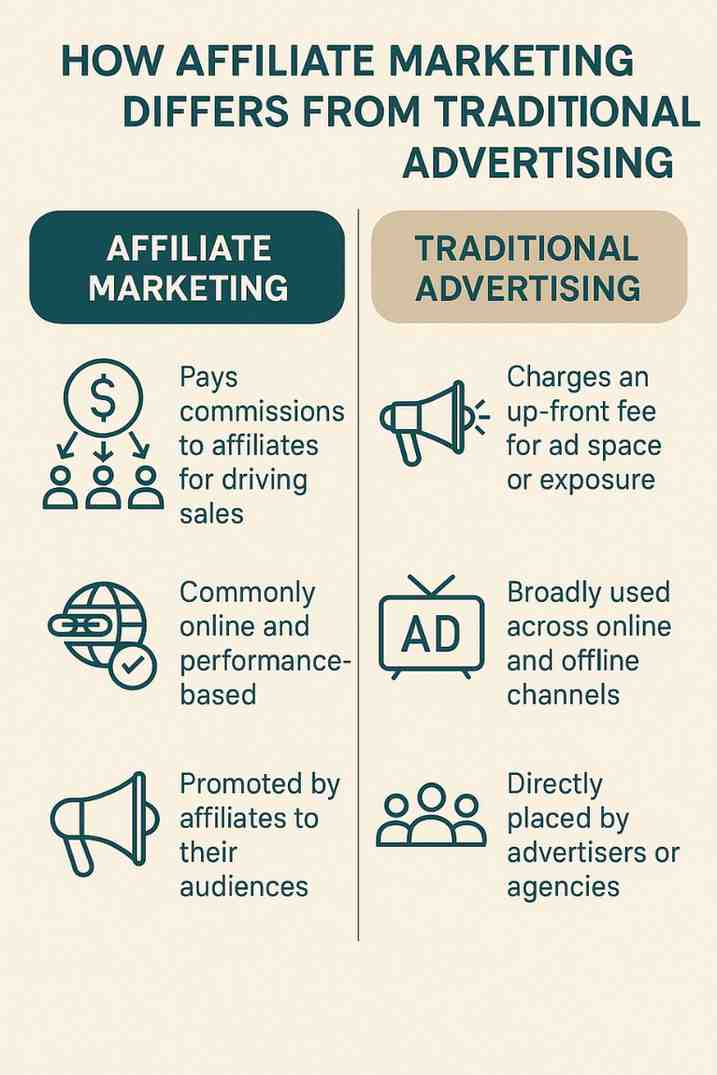
Affiliate marketing and traditional advertising are two common yet distinct methods businesses use to promote their products or services. While both aim to reach and influence consumers, they operate on fundamentally different models, strategies, and cost structures. The digital age has made affiliate marketing increasingly popular, but traditional advertising still remains significant across many industries.

In this comprehensive explanation, we’ll explore the key differences between affiliate marketing and traditional advertising by examining their definitions, structures, methodologies, tracking capabilities, cost models, audience targeting, and effectiveness. A practical example will be included to help illustrate these differences in action.


1. Definition and Core Concept

Affiliate Marketing

Affiliate marketing is a performance-based digital marketing strategy where a business rewards third-party publishers (affiliates) for driving traffic or sales to its website through the affiliate’s own marketing efforts. Affiliates only get paid when a specific action is completed — such as a sale, signup, or download.

In essence, it’s a pay-for-performance model. Businesses leverage the reach and influence of affiliates (bloggers, influencers, YouTubers, etc.) to promote their offerings.

Traditional Advertising

Traditional advertising refers to more conventional forms of marketing — such as TV commercials, radio spots, billboards, newspaper ads, magazine placements, and flyers. These ads are typically created and paid for upfront, regardless of how effective they are in driving results.

Traditional advertising is generally pay-for-exposure rather than performance. Companies invest in media space and time to raise awareness, not necessarily to guarantee conversions.


2. Cost Model

Affiliate Marketing:

  • Performance-Based: Advertisers pay affiliates only when a predetermined action occurs (e.g., a purchase, form submission).

  • Low Risk: There’s minimal financial risk because businesses don’t pay unless results are delivered.

  • Flexible Commission Structures: Advertisers can offer flat-rate payments, tiered commissions, or percentages of sales.

Traditional Advertising:

  • Upfront Payments: Advertisers must pay in advance to buy ad space or time, regardless of the campaign’s results.

  • High Cost: Especially for TV, radio, or print ads, the costs can be significantly higher due to production and distribution expenses.

  • No Guarantee of Return: Businesses might invest heavily without a clear return on investment (ROI).


3. Reach and Targeting

Affiliate Marketing:

  • Niche Targeting: Affiliates often have dedicated audiences in specific niches (e.g., fitness, tech, finance). This allows for targeted promotions that speak directly to consumer needs.

  • Trust Factor: Consumers tend to trust product recommendations from influencers or bloggers they follow regularly.

  • Data-Driven: Affiliates can use analytics tools to tailor promotions to user behavior, making the targeting highly specific and personal.

Traditional Advertising:

  • Broad Reach: Traditional advertising targets a general audience. For example, a TV commercial during prime time may reach millions, but many viewers may not be potential customers.

  • Less Personalization: Ads are standardized and not tailored to individual viewer preferences.

  • Mass Market Strategy: It works well for brand awareness campaigns but is less effective for direct-response goals.


4. Channel and Medium

Affiliate Marketing:

  • Digital Platforms: Operates entirely online — through websites, social media platforms, email marketing, podcasts, and YouTube.

  • Content-Centric: The focus is on content that educates, reviews, or entertains while subtly promoting the product.

  • SEO and Social Media Driven: Organic traffic and engagement are key drivers of success.

Traditional Advertising:

  • Offline Media: Uses physical or broadcast channels like television, radio, newspapers, and billboards.

  • Ad-Centric: Content is solely promotional and interruptive in nature (e.g., commercial breaks, print ad spreads).

  • Event-Based: Traditional ads are often tied to events, seasons, or specific time slots.


5. Measurement and Tracking

Affiliate Marketing:

  • Precise Tracking: Uses tracking links, cookies, and affiliate IDs to monitor user behavior from click to conversion.

  • Real-Time Analytics: Affiliates and merchants can access dashboards showing performance metrics (click-through rate, conversion rate, etc.).

  • Attribution Clarity: Affiliates get credit for referrals, and merchants know exactly which affiliate drove which result.

Traditional Advertising:

  • Limited Tracking: It’s difficult to measure how many people took action because of a TV or billboard ad.

  • Estimates and Surveys: Businesses rely on third-party agencies for ratings, reach estimates, and consumer feedback.

  • Less Attribution: Hard to know which channel or campaign led to a purchase unless the customer self-reports.


6. Payment Structure

Affiliate Marketing:

  • Commission-Based: Payment is tied to measurable actions like purchases, signups, or app installs.

  • Flexible Payout Models: Options include pay-per-sale (PPS), pay-per-click (PPC), and pay-per-lead (PPL).

  • Scalable Costs: As sales increase, so does the cost — but so does revenue.

Traditional Advertising:

  • Flat-Rate Pricing: Pay a set amount for a defined duration, reach, or ad size, regardless of effectiveness.

  • No Direct Link to Sales: You pay for visibility, not outcomes.

  • One-Time Investment: No recurring cost tied to actual product sales or consumer actions.


7. Involvement of Third Parties

Affiliate Marketing:

  • Involves affiliates who act as independent marketers. They choose which products to promote and how to promote them.

  • May also involve affiliate networks (e.g., CJ Affiliate, ShareASale) that connect merchants with affiliates, manage tracking, and handle payments.

Traditional Advertising:

  • Involves advertising agencies, creative studios, media buyers, and sometimes celebrities or spokespeople.

  • Requires production teams for video shoots, graphic design, and editing.


8. Flexibility and Control

Affiliate Marketing:

  • High Flexibility: Both affiliates and merchants can start, stop, or modify campaigns quickly.

  • Low Barrier to Entry: Anyone with an online presence can become an affiliate.

  • Test-and-Optimize Approach: Campaigns can be optimized in real time for better performance.

Traditional Advertising:

  • Lower Flexibility: Once an ad is published or aired, changes are difficult or impossible.

  • High Barrier to Entry: Requires significant budget, planning, and coordination.

  • One-Shot Campaigns: Less opportunity to refine messaging post-launch.


9. Consumer Perception

Affiliate Marketing:

  • Feels more organic and personal — often part of helpful content like reviews or tutorials.

  • Consumers often don’t mind affiliate links if the content is valuable and trustworthy.

  • Less intrusive and more native to the platform (e.g., a YouTube video reviewing a product).

Traditional Advertising:

  • Seen as interruptive — breaks in shows, pop-up ads in magazines, or loud commercials.

  • May lead to ad fatigue — consumers skipping or ignoring the ad altogether.

  • Often more about branding than utility.


10. Example: Fitness Product Promotion

Let’s compare how a company might promote a new protein supplement using both affiliate marketing and traditional advertising.

Affiliate Marketing Scenario:

A fitness brand partners with a popular fitness YouTuber and offers them an affiliate link to the new supplement.

  • The YouTuber posts a video titled “Best Protein Supplements for Lean Muscle” and includes a link in the description.

  • Viewers trust the YouTuber’s expertise and click the link to make a purchase.

  • The affiliate earns a 15% commission on each sale.

  • The company only pays when a sale happens.

Traditional Advertising Scenario:

The same brand buys a 30-second ad slot on a sports TV channel.

  • The ad airs during a cricket match, watched by millions.

  • Many viewers see the ad, but the brand has no direct way to measure how many of them purchased the product.

  • The ad costs ₹10,00,000 for one slot, whether it results in sales or not.

  • There is no direct engagement or feedback from consumers.


Conclusion

Affiliate marketing and traditional advertising are both valuable in their own right, but they differ significantly in approach, strategy, and execution.

Aspect Affiliate Marketing Traditional Advertising
Payment Model Performance-based (e.g., per sale or lead) Upfront payment for ad space or time
Risk Level Low (pay only when results are delivered) High (pay regardless of results)
Targeting Highly targeted and niche Broad and general
Tracking Real-time, detailed tracking available Limited tracking, estimates based on reach
Cost Efficiency Cost-effective and scalable Expensive with no guaranteed ROI
Consumer Perception Organic and trustworthy Often interruptive or ignored

While traditional advertising is ideal for brand-building and reaching large audiences quickly, affiliate marketing excels in performance, accountability, and adaptability. In today’s data-driven and digital world, affiliate marketing provides businesses — especially small and medium enterprises — a practical and profitable path to grow sales with lower risk and better targeting.

Each model has its place in a comprehensive marketing strategy, but understanding the differences is essential for choosing the right approach for specific business goals.

Explain the role of the affiliate, advertiser, and consumer in affiliate marketing.

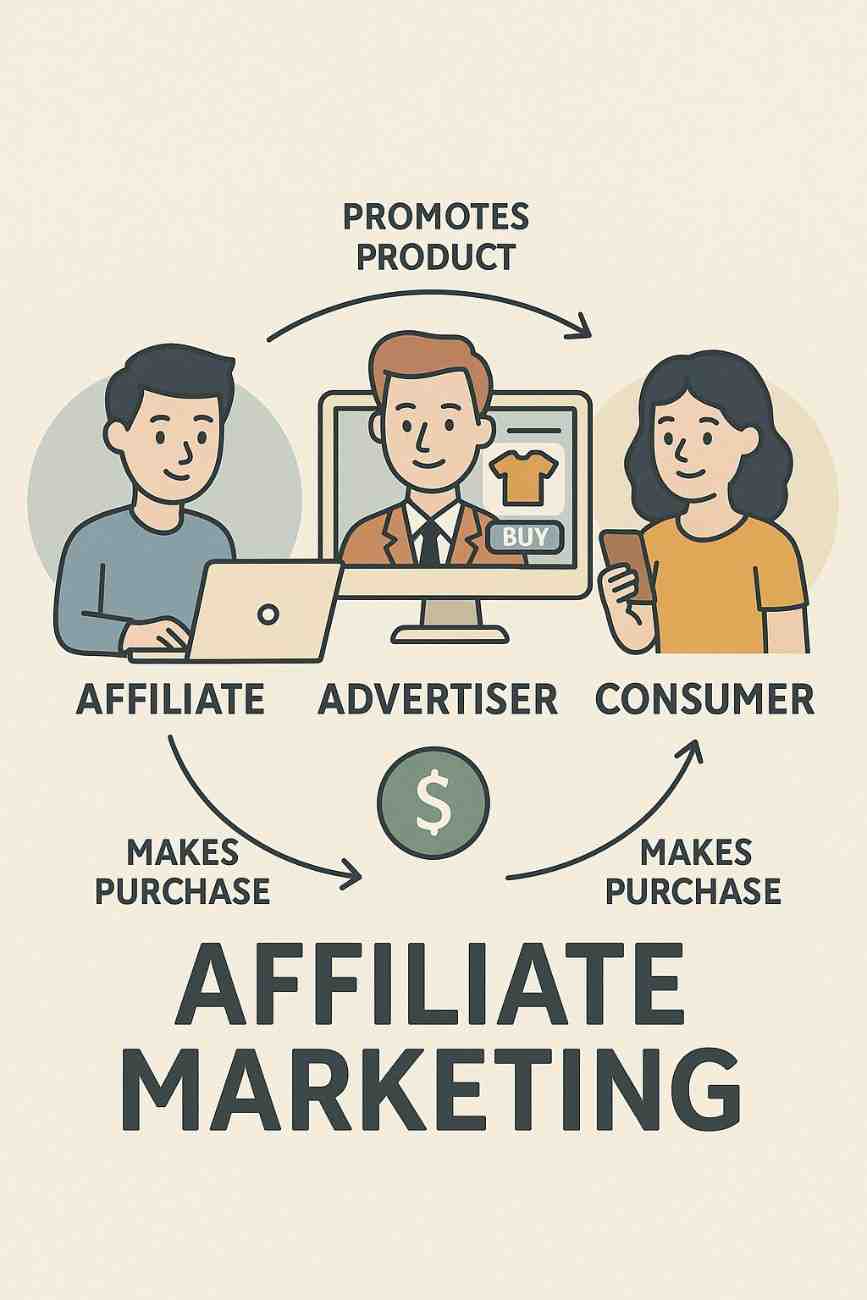
Affiliate marketing is a performance-based marketing strategy that benefits multiple parties through collaboration and mutual gain. It connects product creators or service providers (advertisers or merchants) with marketers or promoters (affiliates), who recommend these offerings to end-users (consumers). In this system, each participant has a distinct and crucial role that ensures the effectiveness of the affiliate marketing ecosystem.

This essay explores in detail the specific roles of the affiliate, advertiser, and consumer in affiliate marketing, how they interact, and how their roles collectively create a successful marketing process. A real-world example is provided at the end for better understanding.


1. Understanding Affiliate Marketing at a Glance

Affiliate marketing is built on a simple premise: affiliates promote products or services using unique tracking links, and when consumers buy through those links, the affiliate earns a commission. The advertisers benefit from additional exposure and increased sales, while consumers are introduced to useful products or services—often in a more personalized or organic way.

The three primary stakeholders in this model are:

  1. Affiliate (Publisher)

  2. Advertiser (Merchant/Product Creator)

  3. Consumer (Customer/Buyer)

Let’s now break down each of their roles.


2. The Role of the Affiliate

The affiliate, also known as a publisher or partner, plays the role of the promoter or marketer. Affiliates help advertisers reach their target audience by recommending or endorsing the advertiser’s products or services. The affiliate uses various content strategies and platforms to attract potential consumers.

Key Responsibilities of Affiliates:

a. Promoting Products or Services
Affiliates create engaging and persuasive content to market products. This content can be in the form of:

  • Blog posts or articles

  • YouTube videos

  • Instagram or Facebook posts

  • Email newsletters

  • Podcast episodes

  • Product reviews or comparisons

b. Building Trust with the Audience
Successful affiliates maintain a trustworthy relationship with their audience. They only promote products they genuinely believe in or have used themselves. This trust increases the chances of their audience purchasing through their affiliate links.

c. Driving Traffic
The affiliate is responsible for driving targeted traffic to the advertiser’s website or product page. This is often achieved through SEO (Search Engine Optimization), paid ads, social media, or direct outreach.

d. Using Unique Affiliate Links
Every affiliate is assigned a unique tracking ID or link that helps the advertiser trace back any sale or conversion to the specific affiliate. This ensures the affiliate is credited correctly for the referral.

e. Optimizing Performance
Affiliates continuously analyze their promotional efforts. They track click-through rates (CTR), conversion rates, and commissions earned. This data allows them to refine their strategy to improve results.

Types of Affiliates:

  • Bloggers

  • Influencers

  • Coupon or deal sites

  • Niche review sites

  • Email marketers

  • Affiliate networks or agencies


3. The Role of the Advertiser

The advertiser, also called the merchant, vendor, or product owner, is the individual or company that owns the product or service being promoted. They create an affiliate program to partner with affiliates and pay them a commission for every successful referral.

Key Responsibilities of Advertisers:

a. Offering Products or Services
Advertisers must have a product or service ready for sale. These can range from physical goods (like shoes, gadgets) to digital products (like online courses, software, or eBooks).

b. Creating an Affiliate Program
The advertiser designs the affiliate program’s structure. This includes:

  • Commission rates (e.g., 10% per sale)

  • Cookie duration (e.g., 30-day tracking)

  • Payment terms (monthly, bi-weekly, etc.)

  • Marketing materials (banners, product images, email templates)
    Some businesses manage this in-house, while others use affiliate networks like CJ Affiliate, ShareASale, or ClickBank.

c. Providing Tracking and Reporting Tools
Advertisers offer tools that track affiliate performance, such as:

  • Number of clicks

  • Number of conversions

  • Total sales

  • Commissions owed
    This transparency ensures affiliates can monitor their success and build trust in the system.

d. Ensuring Product Quality and Customer Experience
The advertiser must deliver a product that meets customer expectations. A poor product or bad service can damage both the affiliate’s reputation and the advertiser’s brand.

e. Paying Affiliates
Based on the affiliate’s performance, advertisers pay commissions. These payments are processed through bank transfer, PayPal, or other financial systems. Payment reliability is crucial to maintaining good relationships with affiliates.

Types of Advertisers:

  • E-commerce brands (Amazon, Flipkart)

  • SaaS companies (Shopify, SEMrush)

  • Online course creators (Udemy, Coursera)

  • Service providers (insurance, finance, travel)


4. The Role of the Consumer

The consumer is the target audience of the affiliate’s marketing efforts and the one who ultimately completes the purchase or desired action. Although the consumer is not an active participant in the affiliate marketing agreement, they are the central figure around which the system revolves.

Key Characteristics and Responsibilities of Consumers:

a. Making Informed Decisions
Consumers typically discover products through affiliate-created content like reviews, videos, or social media posts. This content helps them make informed purchasing decisions.

b. Clicking on Affiliate Links
Consumers click on affiliate links embedded in content. These links are tracked using cookies, which help identify the affiliate who referred the customer.

c. Completing the Desired Action
This could be:

  • Making a purchase

  • Signing up for a service

  • Downloading an app

  • Filling out a form

Once this action is completed, the affiliate gets credited with a commission.

d. Trusting the Source
The consumer often trusts the affiliate more than traditional advertising, especially when the affiliate is a known influencer or blogger. This trust plays a crucial role in conversion.

e. Experiencing the Product/Service
Consumers expect a seamless and satisfying post-purchase experience. If the product or service meets their expectations, it increases brand loyalty and the likelihood of repeat business — possibly through future affiliate links.


5. Example of How These Roles Interact

Let’s take an example to understand how the affiliate, advertiser, and consumer interact in a real-world scenario.

Example: Tech Blogger Promoting a Smartphone

  • Advertiser: Samsung has launched a new mid-range smartphone and wants to increase its online sales. They have an affiliate program offering a 5% commission on every sale.

  • Affiliate: A tech blogger who writes gadget reviews joins the Samsung affiliate program. The blogger receives a unique affiliate link to the smartphone.

  • Consumer: A reader searching for a budget-friendly smartphone visits the blogger’s website and reads a detailed review of the Samsung phone.

How it plays out:

  1. The blogger writes a review titled “Top Smartphones Under ₹25,000 in 2025” and includes the affiliate link to the Samsung phone.

  2. A reader (consumer) clicks on the affiliate link and is redirected to Samsung’s official website.

  3. The reader decides to purchase the phone.

  4. The purchase is tracked via the affiliate link.

  5. Samsung records the sale and credits the blogger with a 5% commission.

  6. The blogger receives the payment in the next payout cycle.

In this scenario:

  • Samsung (advertiser) gains a sale without spending on upfront advertising.

  • The blogger (affiliate) earns passive income for sharing useful content.

  • The consumer finds a product that suits their needs, backed by a trusted source.


6. Conclusion

Affiliate marketing is a dynamic and collaborative strategy that hinges on the successful interaction between affiliates, advertisers, and consumers. Each participant has a specific role that contributes to the ecosystem’s functionality and efficiency.

  • Affiliates are the content creators and marketers who promote products.

  • Advertisers are the providers of those products and the originators of the affiliate programs.

  • Consumers are the end-users whose actions generate the revenue and commissions.

Together, they form a triangle of trust and transaction, each dependent on the other. When executed properly, affiliate marketing can create a win-win-win scenario: advertisers expand their reach, affiliates earn income, and consumers discover valuable products or services.

As the digital economy continues to grow, affiliate marketing will remain a powerful tool in the arsenal of e-commerce, content marketing, and online entrepreneurship. Understanding the distinct roles of each player is the first step in leveraging this model to its full potential.

Explain how Facebook helps in connecting people globally.


Introduction

In a world increasingly shaped by digital communication, few platforms have played as significant a role in global connectivity as Facebook. Launched in 2004, Facebook has evolved into more than just a social networking site—it is a powerful global tool for communication, collaboration, and community-building. With over 2.9 billion monthly active users, Facebook transcends geographical, cultural, and linguistic boundaries, offering individuals and organizations the ability to connect across continents in real time.

In this article, we’ll explore how Facebook helps in connecting people globally, looking at its features, societal impact, and a real-world example that illustrates its power to unite people across the world.


Facebook as a Global Connector

From its inception, Facebook’s core mission has been to “give people the power to build community and bring the world closer together.” Over the years, the platform has developed a wide range of tools and services that facilitate connection, regardless of location or background. Here’s how Facebook achieves this:


1. Bridging Geographic Barriers

One of Facebook’s most transformative impacts has been its ability to eliminate physical distance in communication. People separated by thousands of miles can now stay in touch through:

  • Instant Messaging via Facebook Messenger
  • Video Calls and Voice Chats
  • Status Updates and Photo Sharing
  • Live Streams for Real-Time Interaction

Whether it’s a student studying abroad, a migrant worker away from family, or friends living in different countries, Facebook provides a virtual space for real-time interaction and emotional connection.

Example:

A mother in the Philippines can video chat with her daughter working in Canada using Facebook Messenger every night. They can share updates, photos, and even celebrate birthdays virtually through Facebook’s tools—maintaining a strong family bond despite the distance.


2. Multilingual Accessibility

Facebook is available in over 100 languages, making it truly global in scope. The platform’s language settings allow users to switch between their native language and others, and its automatic translation feature helps break language barriers. This multilingual support enables cross-cultural communication in ways previously unimaginable.

For instance, an English-speaking user in the United States can interact with a Spanish-speaking user in Argentina, as Facebook automatically translates posts and comments, making dialogue seamless and inclusive.


3. Connecting Diaspora Communities

Facebook has become a vital tool for diaspora communities who want to stay connected to their culture, traditions, and hometown networks. Many immigrants use Facebook to follow news from their home countries, join groups based on ethnicity or regional origin, and participate in community discussions.

These groups serve as digital villages—supporting cultural preservation, offering advice, and even organizing real-world events in foreign countries. Examples include groups for Nigerian professionals in the UK, Indian students in the U.S., or Filipino workers in the Middle East.


4. Building Communities Through Groups

Facebook Groups are among the platform’s most powerful features for fostering connection. With millions of groups covering virtually every interest, hobby, profession, and cause, users can find like-minded individuals anywhere in the world.

Whether it’s a group for amateur photographers, cancer survivors, remote workers, or language learners, Facebook provides a sense of belonging that isn’t bound by geography.

Example:

A group called “Expats in Berlin” connects thousands of foreign nationals living in Berlin. Members share local tips, job opportunities, housing options, and support each other emotionally. A newcomer moving to the city can instantly feel less isolated by joining this vibrant online community.


5. Facilitating Social Movements and Awareness

Facebook has played a crucial role in global social movements and humanitarian campaigns. Activists, NGOs, and concerned citizens use Facebook to spread awareness, raise funds, and organize protests or events. Through features like Facebook Events, Live Video, and Fundraisers, users can mobilize support from around the world.

For example, global movements like Black Lives Matter, Fridays for Future, and #MeToo gained momentum through Facebook, drawing international participation and solidarity. Facebook made it possible for individuals in remote parts of the world to contribute to causes that affect humanity on a global scale.


6. Emergency and Crisis Response

In times of natural disasters, conflict, or public health emergencies, Facebook helps users stay safe and informed. The Facebook Crisis Response feature enables users in affected areas to mark themselves as safe, request or offer help, and access verified information.

This tool was particularly valuable during events like the Nepal Earthquake (2015), Hurricane Harvey (2017), and the COVID-19 pandemic. It facilitated rapid communication, resource sharing, and emotional support across borders.


7. Enabling Cross-Border Business and Networking

Facebook has empowered businesses of all sizes to connect with international customers. Through Facebook Pages, Marketplace, and Business Manager, entrepreneurs can advertise and sell globally. Many small businesses in developing countries use Facebook as their primary digital storefront, reaching markets far beyond their local reach.

Additionally, Facebook provides a platform for professional networking and collaboration. Artists, freelancers, educators, and developers frequently connect with peers and clients from around the world via Facebook.


Real-World Example: Facebook’s Role in Refugee Integration

A compelling example of Facebook’s power to connect people globally can be seen in its role during the Syrian refugee crisis. As millions of Syrians fled civil war and sought asylum in Europe and elsewhere, many turned to Facebook for help.

Refugees used Facebook to:

  • Find safe migration routes
  • Connect with family members lost during the journey
  • Join community groups in host countries
  • Learn the local language through peer-led Facebook Groups
  • Share their stories with the world to gain empathy and support

On the other side, citizens in host countries used Facebook to offer shelter, clothing, legal aid, and employment opportunities. Several Facebook Groups emerged across Germany, Sweden, and Canada where local residents and refugees engaged directly, breaking down cultural barriers and building lasting friendships.

This real-world example demonstrates how Facebook not only facilitated basic survival for many refugees but also enabled long-term integration and global solidarity.


The Role of Facebook in Cultural Exchange

Another often overlooked benefit is Facebook’s contribution to cultural exchange. Users are constantly exposed to different traditions, languages, music, cuisines, and ideas through their global connections.

For example, during cultural festivals like Diwali, Ramadan, Christmas, or Chinese New Year, users share photos, traditions, and greetings that help others understand and appreciate different cultures. This fosters empathy, learning, and mutual respect among global citizens.


Challenges and Ethical Concerns

While Facebook’s role in global connectivity is undeniable, it also faces criticism:

  • Misinformation and Fake News: The rapid spread of false information can lead to confusion, especially in global crises.
  • Language Bias in Moderation: Content moderation may be less effective in non-English languages, leading to uneven enforcement of rules.
  • Privacy Issues: In some regions, especially those with authoritarian regimes, Facebook usage can pose risks to users’ privacy and safety.

Despite these challenges, Facebook has implemented tools to flag misinformation, enhance security, and improve moderation in multiple languages.


Conclusion

Facebook has fundamentally changed how humans connect across borders. By enabling real-time communication, creating communities, supporting social movements, and fostering cultural exchange, it has brought the world closer together in ways once only imagined.

Its role as a global connector continues to evolve, especially as it integrates with new technologies under the broader Meta vision of the future. Whether through a video call between long-lost friends, a refugee finding a safe home, or strangers uniting for a global cause, Facebook remains a powerful symbol of digital human connection.

As we move into an even more interconnected world, Facebook’s ability to connect people globally will continue to shape our shared human experience—for better or worse—and that responsibility will be crucial to its future legacy.


What is Affiliate Marketing, and How Does It Work?

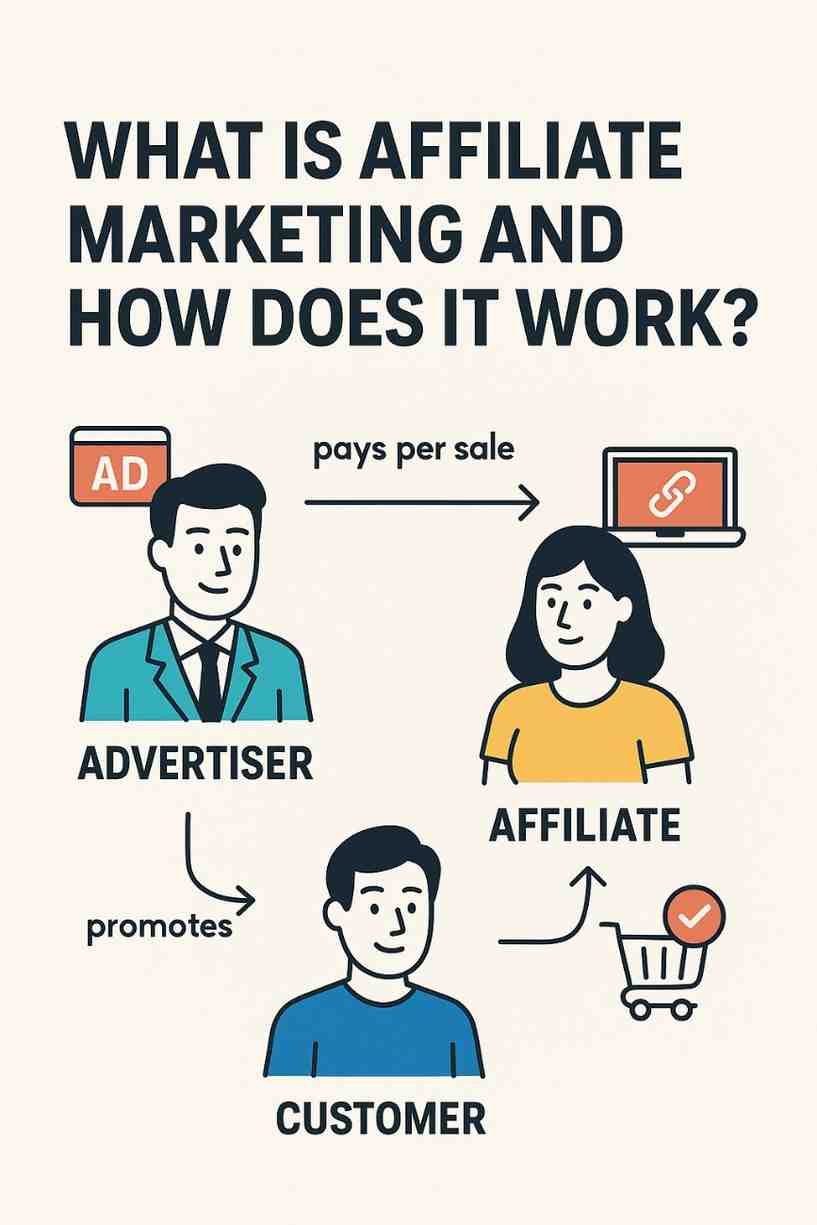
Affiliate marketing is a performance-based marketing strategy where individuals or companies (affiliates) promote products or services of another business (merchant or advertiser) and earn a commission for each sale, lead, or action generated through their referral. It is one of the most effective and scalable ways of monetizing a website, blog, or social media following and has become a core component of many digital marketing strategies.

This model benefits all parties involved: the merchant gains increased sales and reach, the affiliate earns passive income for their promotional efforts, and consumers may discover valuable products or services they wouldn’t have found otherwise. Let’s explore affiliate marketing in-depth, including its mechanics, key players, types, benefits, and a practical example.


1. Understanding Affiliate Marketing

Affiliate marketing functions similarly to a traditional commission-based sales model, except it’s driven through digital platforms. At its core, it’s about revenue sharing. A business rewards affiliates for sending customers their way — usually through a unique tracking link. When a consumer clicks on an affiliate’s link and completes a desired action (like purchasing a product), the affiliate gets a portion of the profit.


2. The Key Players in Affiliate Marketing

To understand how affiliate marketing works, it’s essential to understand the roles of the key participants:

a. Merchant (Advertiser/Product Owner)

The merchant is the individual or company that creates and owns the product or service. They want to sell their offering and are willing to pay others (affiliates) a commission to help promote it. Examples of merchants include companies like Amazon, Nike, and small startups offering software or digital courses.

b. Affiliate (Publisher)

The affiliate promotes the merchant’s products to their audience. Affiliates can be individuals (such as influencers, bloggers, or YouTubers) or businesses (such as review websites or email marketers). Their main role is to generate traffic and drive conversions.

c. Consumer (Customer)

The consumer is the end-user who interacts with the affiliate’s content and makes a purchase or completes a specific action. The transaction is seamless for the consumer; they typically do not pay more because of the affiliate’s commission.

d. Affiliate Network (Optional)

Affiliate networks act as intermediaries between affiliates and merchants. They provide tools to track sales, manage payments, and access affiliate programs. Examples include ShareASale, CJ Affiliate, and ClickBank.


3. How Affiliate Marketing Works

The process can be broken down into several steps:

Step 1: Affiliate Joins a Program

The affiliate signs up for a merchant’s affiliate program, either directly through the merchant’s website or through an affiliate network. Once approved, they receive unique affiliate links or codes to promote products.

Step 2: Promotion of Products

The affiliate integrates these links into their content — such as blog posts, YouTube videos, emails, or social media posts. These promotions may take the form of product reviews, tutorials, comparison guides, or recommendations.

Step 3: Consumer Clicks the Affiliate Link

When a user clicks on the affiliate’s link, a cookie is placed in their browser. This cookie tracks their actions and attributes any subsequent purchases to the affiliate. Cookie durations vary — it could be 24 hours or up to 90 days.

Step 4: Consumer Makes a Purchase or Takes Action

If the consumer makes a purchase (or completes another specified action like filling out a form), the sale is recorded. The affiliate network or software tracks the transaction back to the affiliate’s ID.

Step 5: Affiliate Earns Commission

The affiliate receives a commission based on the agreed terms — this could be a percentage of the sale or a fixed amount per lead or signup. Payments are made periodically, such as monthly or bi-weekly.


4. Types of Affiliate Marketing Models

Affiliate marketing comes in several forms, including:

a. Pay-Per-Sale (PPS)

This is the most common model. The affiliate earns a commission when the customer completes a purchase. For example, Amazon pays 1% to 10% per sale depending on the product category.

b. Pay-Per-Click (PPC)

Affiliates earn money when users click on the affiliate link, regardless of whether they buy. This model is less common, as it carries more risk for the merchant.

c. Pay-Per-Lead (PPL)

Affiliates earn money when referred users complete a desired action, such as signing up for a free trial or subscribing to a newsletter. This is often used for software, insurance, or financial services.


5. Benefits of Affiliate Marketing

Affiliate marketing offers advantages for both affiliates and merchants:

For Affiliates:

  • Low Startup Costs: No need to create or own a product.

  • Passive Income Potential: Earn commissions long after the content is published.

  • Flexibility: Work from anywhere and promote products you believe in.

  • Scalability: You can promote multiple products across platforms and grow your income.

For Merchants:

  • Cost-Effective Marketing: Pay only for performance (sales or leads).

  • Broader Reach: Access new audiences via affiliates’ channels.

  • Increased Credibility: Consumers often trust affiliates more than direct ads.


6. Challenges in Affiliate Marketing

Despite its benefits, affiliate marketing also presents certain challenges:

  • High Competition: Many affiliates promote the same products, making it hard to stand out.

  • Commission Cuts: Merchants can reduce commission rates or cancel programs at any time.

  • Affiliate Fraud: Some affiliates may try to manipulate the system using fake leads or clicks.

  • Dependency on Merchant: If a program closes or a product becomes obsolete, affiliate income may vanish.


7. Tools and Strategies for Successful Affiliate Marketing

To succeed in affiliate marketing, affiliates often use several tools and strategies:

a. Content Creation

High-quality content that adds value — like tutorials, reviews, or how-to guides — can drive traffic and conversions.

b. SEO (Search Engine Optimization)

Optimizing content for search engines helps attract organic traffic. Keyword research, on-page SEO, and backlinking are essential components.

c. Email Marketing

Building an email list allows affiliates to nurture relationships and promote relevant offers directly.

d. Social Media

Platforms like Instagram, Facebook, and Pinterest can be used to promote affiliate products, especially for niches like fashion, beauty, and lifestyle.

e. Analytics Tools

Tracking tools such as Google Analytics, affiliate dashboards, and custom UTM links help affiliates measure performance and optimize campaigns.


8. Real-World Example: Amazon Associates Program

One of the best-known examples of affiliate marketing is the Amazon Associates Program.

How it works:

  • An affiliate (say, a tech blogger) joins the program and gets a unique affiliate link for a product like a smartphone.

  • They write a blog post titled “Top 5 Smartphones Under ₹30,000 in 2025” and include the affiliate link for the recommended phone.

  • A reader visits the blog, clicks on the link, and buys the phone on Amazon.

  • The blogger earns a commission — say 4% of the sale price.

Amazon’s affiliate program also pays commissions for additional products purchased by the customer during the same session — even if they weren’t part of the affiliate’s content.


9. Future Trends in Affiliate Marketing

Affiliate marketing continues to evolve. Here are some notable trends:

  • Influencer Marketing Integration: Social influencers are playing a greater role in affiliate strategies.

  • AI and Automation: Tools are helping automate content creation, link management, and performance tracking.

  • Voice and Video Search Optimization: As voice search and video content grow, affiliates are optimizing for these formats.

  • Niche Focus: Affiliates are narrowing their focus to specific niches to build stronger audience trust and engagement.


10. Conclusion

Affiliate marketing is a powerful and accessible way for individuals and businesses to generate income online by promoting products and services of other brands. It thrives on trust, quality content, and audience engagement. With minimal investment, affiliates can build a sustainable revenue stream, while merchants gain from cost-effective exposure and increased sales.

Whether you’re a blogger, influencer, or marketer, understanding the mechanics and strategies behind affiliate marketing can open the door to significant digital earning opportunities. Like any business model, success depends on effort, patience, consistency, and continuous learning.

What is Facebook, and how has it evolved since its launch in 2004?


Introduction

Facebook is a social media platform that has revolutionized how people connect, communicate, and share information across the globe. Since its launch in 2004, it has undergone a remarkable transformation—from a niche college networking site to one of the world’s largest digital ecosystems. With billions of users, Facebook has played a significant role in reshaping communication, marketing, media, and even politics.

In this article, we’ll explore what Facebook is, how it started, and how it has evolved over the years, including key milestones, technological developments, controversies, and its broader impact on society. We’ll also look at a real-world example to illustrate this evolution in action.


What Is Facebook?

Facebook is a social networking service where users can create personal profiles, connect with friends, share multimedia content, and interact with individuals, groups, and businesses. Its core features include:

  • Personal Timelines or Profiles: Where users display their posts, photos, and life events.
  • News Feed: A constantly updating list of friends’ and Pages’ posts.
  • Friends and Followers: Options to connect with others or follow public profiles.
  • Messenger: A separate messaging app for chatting in real-time.
  • Groups and Pages: Tools for community building and business engagement.
  • Marketplace: A platform for buying and selling items locally.
  • Reels and Stories: Short-form video and photo sharing options.

Owned by Meta Platforms, Inc. (formerly Facebook, Inc.), the platform remains a critical part of the social media landscape despite the rise of newer competitors like TikTok and Snapchat.


The Birth of Facebook: 2004

Facebook was created by Mark Zuckerberg along with his college roommates at Harvard University. Originally called “TheFacebook”, it launched on February 4, 2004, as an exclusive network for Harvard students. Its goal was to help students connect online using real identities.

Within months, the platform expanded to other Ivy League universities and later to colleges across the United States and Canada. By 2006, Facebook became available to anyone aged 13 and older with a valid email address, marking a significant turning point in its public adoption.


Facebook’s Key Milestones and Evolution

1. Expansion and Growth (2006–2010)

  • News Feed Launch (2006): The introduction of News Feed revolutionized how users consumed content, displaying updates from friends in real time. Though initially met with resistance over privacy concerns, it quickly became the core of the platform.
  • Facebook Platform (2007): Developers were allowed to build third-party apps, leading to viral games like FarmVille, which attracted millions of users and kept them engaged for hours.
  • Global Reach: By 2008, Facebook overtook MySpace as the most popular social network in the world. It also launched in multiple languages to support global expansion.
  • “Like” Button (2009): A simple but powerful feature that increased user interaction and became a universal symbol of digital approval.

2. The Mobile Era and IPO (2011–2015)

  • Mobile App Development: As smartphones took over, Facebook invested heavily in mobile apps, ensuring users could stay connected on the go.
  • Acquisition of Instagram (2012): In a strategic move, Facebook bought photo-sharing platform Instagram for $1 billion. At the time, Instagram had only 30 million users, but its integration helped Facebook dominate visual social media.
  • Facebook Messenger (2011–2014): Initially a part of the Facebook app, Messenger was spun off into a separate app, allowing users to chat, make video calls, and send payments.
  • IPO (2012): Facebook went public, raising $16 billion and achieving a valuation of over $100 billion—one of the largest tech IPOs in history.

3. Diversification and Data Concerns (2016–2018)

  • Acquisition of WhatsApp and Oculus (2014): Facebook acquired WhatsApp for $19 billion and Oculus VR for $2 billion, signaling its interest in messaging and virtual reality.
  • Facebook Live (2016): The launch of live video streaming allowed users and brands to broadcast in real-time, leading to new forms of content consumption.
  • Cambridge Analytica Scandal (2018): One of Facebook’s most significant controversies, this data breach affected over 87 million users and sparked global debates on privacy, ethics, and misinformation.

4. Rebranding and the Metaverse (2019–Present)

  • Focus on Groups and Communities: Facebook began shifting its strategy to promote meaningful interactions, focusing on Groups, Events, and smaller communities.
  • Reels (2021): A direct response to TikTok, Reels offered users short-form, vertical video formats with editing tools and music.
  • Meta Rebrand (2021): Facebook Inc. rebranded to Meta Platforms, Inc. to reflect a new focus on building the metaverse—a virtual reality-based future internet. Facebook, as a product, remained a major part of the Meta ecosystem.
  • AI and Algorithm Enhancements: Facebook uses AI to manage content recommendations, detect hate speech, and personalize user experiences, though these systems have sparked criticism for amplifying polarization.

Real-World Example: The Arab Spring and Facebook’s Role

A significant example of Facebook’s societal impact is its role during the Arab Spring uprisings (2010–2012). Protesters in countries like Egypt, Tunisia, and Libya used Facebook to organize rallies, share videos of government abuses, and communicate across borders. The platform enabled activists to spread their messages rapidly without relying on state-controlled media.

In Egypt, a Facebook page titled “We Are All Khaled Said” helped spark widespread protests that eventually led to the resignation of President Hosni Mubarak. This example demonstrates how Facebook evolved from a social app into a powerful tool for social and political mobilization.

However, the same features that empowered activists have also been used to spread propaganda and misinformation in other contexts. This duality highlights both the promise and the peril of Facebook’s influence.


Challenges and Criticisms

Despite its success, Facebook has faced numerous criticisms:

  • Privacy Violations: Data collection practices have been a frequent point of controversy.
  • Mental Health Concerns: Studies suggest that excessive use, especially among teens, may contribute to anxiety, depression, and social comparison.
  • Fake News and Algorithmic Bias: Facebook’s algorithms have been accused of promoting sensational or false content for engagement.
  • Market Dominance: Regulators have scrutinized Facebook’s acquisitions and data practices as potentially anti-competitive.

These challenges have forced Facebook to introduce changes, such as privacy controls, content moderation tools, and partnerships with fact-checkers.


Facebook in 2025: Where Is It Now?

As of 2025, Facebook remains a major social network with over 2.9 billion monthly active users. While its growth has plateaued in some Western markets, it continues to expand in regions like Africa, Asia, and Latin America.

Its role has evolved in multiple ways:

  • Business Tool: Facebook is essential for small and medium-sized enterprises (SMEs) to advertise, engage with customers, and sell products.
  • Content Creation Platform: Creators now use Facebook to publish videos, host live events, and monetize through ads or fan subscriptions.
  • Crisis Communication: Governments and NGOs use Facebook to distribute information during emergencies, health crises, and natural disasters.

Through initiatives like Facebook Marketplace, Facebook Dating, and Facebook Gaming, the platform continues to diversify its offerings.


Conclusion

Facebook has come a long way since its modest beginnings in a Harvard dorm room. Its evolution reflects broader trends in technology, media, and society. From a simple platform for college students to a global force shaping communication, culture, and commerce, Facebook’s impact is undeniable.

While it faces challenges from newer platforms and growing regulation, Facebook remains a dominant player in the social media industry. Its integration with Meta’s broader vision for the metaverse could define its future, but its legacy as a pioneer of social networking is already firmly established.

As technology and user behavior continue to evolve, so too will Facebook—whether as a standalone platform or as part of a broader digital ecosystem under Meta’s leadership.


How to Become a Digital Marketing Specialist

Digital marketing is one of the fastest-growing fields today. Many people are interested in building a career in digital marketing, and becoming a digital...

What is SMM in Digital Marketing

SMM, or Social Media Marketing, is one of the most important parts of digital marketing. In simple words, SMM is the process of using...

What is Google Analytics in Digital Marketing

Google Analytics is one of the most important tools in digital marketing. It helps businesses understand how people interact with their websites and online...

What is Google AdWords in Digital Marketing

Google AdWords is one of the most important tools in digital marketing. Many businesses use AdWords to reach their target audience online and increase...

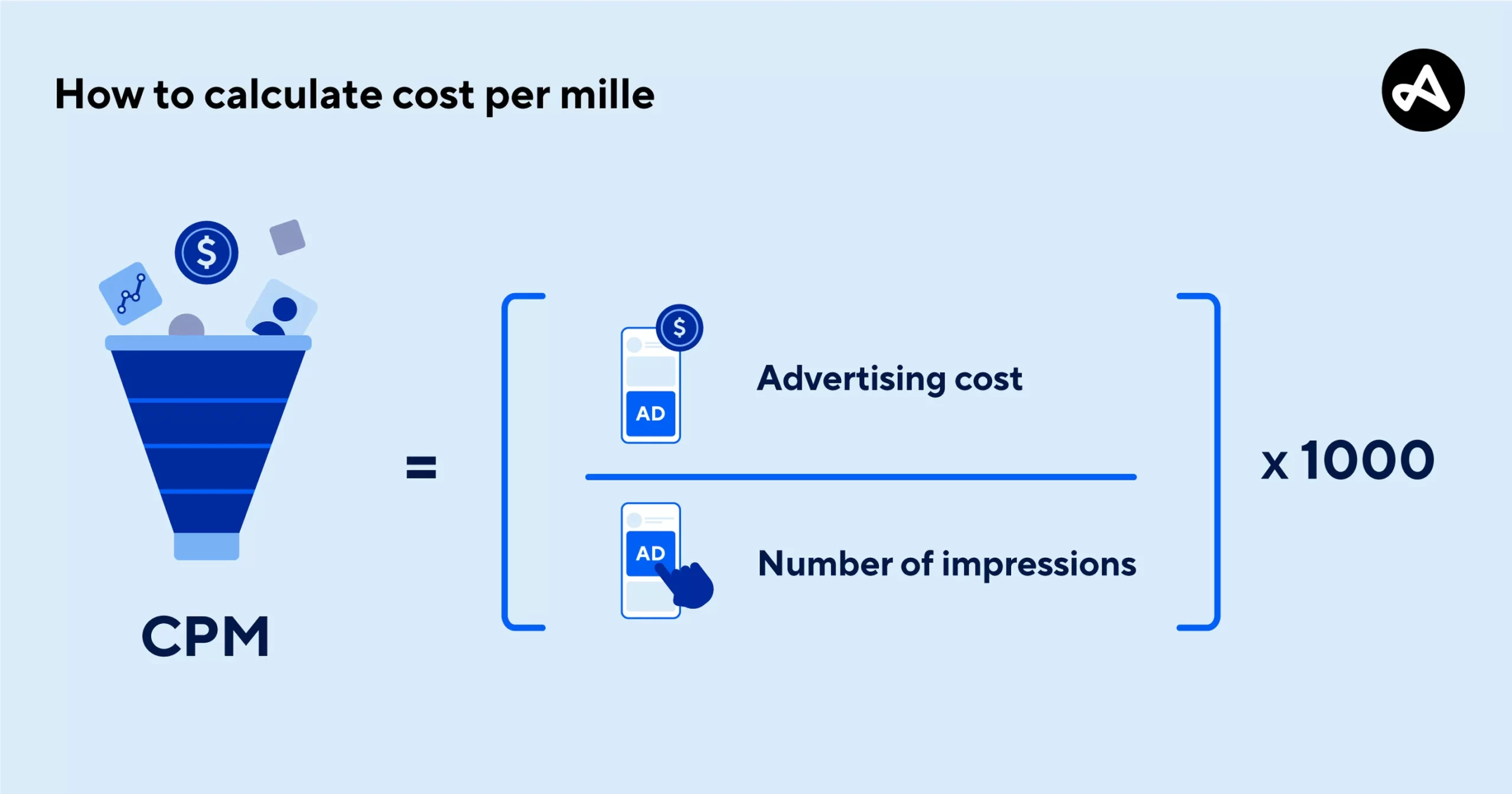
What Is CPM in Digital Marketing

In digital marketing, understanding how your ads are priced and measured is very important. Different advertising models help marketers track performance and control spending....